Mar 24, 2010

lost in L.A.

More photos taken during a trip to the West Coast...

After driving by the Hoover Dam and taking a pit-stop at the Grand Canyon, we drove several hours to Los Angeles. To my surprise, I loved L.A.. A sprawling, never-ending city, its mixture of buzzing city, eclectic architecture, and warm beaches really made a good first impression on me. With much more to say, L.A. is like a far more substantial and interesting Miami.

We spent three short days there, in which I managed to visit the 1940-80 portion of MOCA, LA's expansive 30th Anniversary permanent collection exhibition, the eccentric Museum of Neon Art, much of downtown's great architecture, Santa Monica Beach and Pier, too much of Hollywood (by foot no less) including the legendary Amoeba Records, and Olvera Street. I could have gotten lost there for weeks.


Now some of MOCA, LA, where I fell in love with James Rosenquist, discovered Bridget Riley, and rediscovered Lichtenstein and many other greats.

Below, A hypnotizing work by Doug Wheeler, RM 669, 1969.


On the floor Barry Le Va's great Shatterscatter (Within the Series of Layered/Pattern Acts), 1968-71, and on the wall to the left, the longest movie ever made, Tony Conrad's witty Yellow Movie.


and behind me in the same room...
Bruce Nauman's Four Corner Piece, 1971. I couldn't get enough of this work! Hey, that's me on TV!


I took a couple fun, multi-exposure shots with my Lomo Diana Mini at the Museum of Neon Art.


In Hollywood...


A great Samuel L. Jackson impersonator in Hollywood. He was more than willing to pose and look away as I took the picture. Maybe I should've given him some kind of monetary compensation...


Olvera Street / El Pueblo de Los Angeles. Mmm, Mexican food and prostituted dancing child entertainers.


The dizzying lights of the street vendors there.


At a yummy Mexican restaurant my dad posed like a conquistador for me; something I will be forever grateful for.


We got to Santa Monica beach and the pier just as the sun began to set and it was epic! Certainly a touristy thing to do, but popular for a reason.


I love the disappearing palm trees and pier in this one.


These two were taken while riding on the roller-coaster on the pier.


We finished off the day a great little Italian restaurant somewhere in Venice Beach.

Mar 23, 2010

the controlled chaos of it all

Think of Arnaud Desplechin's A Christmas Tale as the more serious, much more French version of The Royal Tenenbaums. Then forget I even said that.

Never have I seen such a controlled portrayal of the chaos of real life, love, family, etc. This masterpiece is a crisp, utterly beautiful depiction of a family, with all its many eccentricities, reuniting for Christmas after many years of induced separation. Brought together by the family's dying mother, played brilliantly by the stunning Catherine Deneuve, the roller coaster Desplechin puts the viewer through is harrowing, grueling, touching, transcendental, and ultimately uplifting in a way few films are. It exalts one's heart with something quite unquantifiable but all too warm and real.

The film's techniques are understated and refined. The shifts in background music from one scene to the next. The way we don't really relate, or want to relate, to any single character. The use of jump cuts, split screen, and many other New Wave camera approaches. It all melds effortlessly and nearly unnoticeably, always in favor of a greater cause, a great film I feel the need to see at least... eh, twice more.

Mar 15, 2010

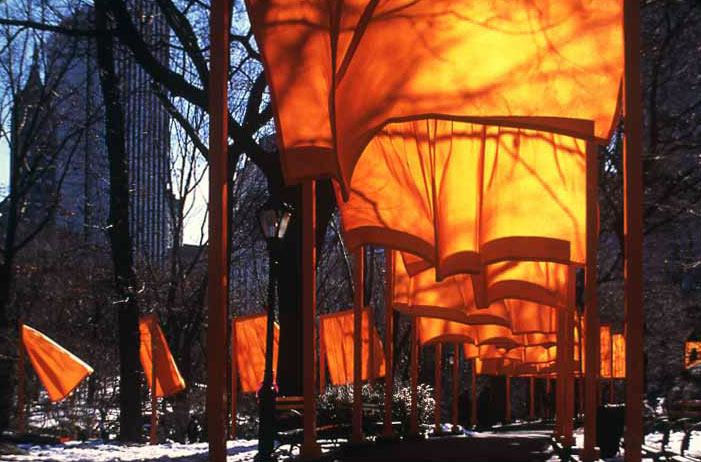
Christo and Jeanne-Claude, the politics of their art: part 5

Ok, so this is it. This is the last part. Done. I think I stretched this out about as long as was need for no one to read anything past the third part. Why do I love Christo and Jeanne-Claude so much? If I could answer that I would be a much happier person.

To be honest, I kind of love how I end this essay. And now that I'm finished posting it all, I'd love to know what you think.

To catch up, read part 1 here, part 2 here, part 3 here, and part 4 here.

Christo and Jeanne-Claude, the Politics of their Art: How they are (shrewdly and discreetly) Socialist, Anti-American and Revolutionary - part 5

They, like most truly great artists, are walking contradictions, at times claiming their work has no politics, at others attributing diverse avant-garde, often political and socialist implications to their art. They are utterly inflexible in their views, especially when it concerns the way their works are constructed and presented. However, they are gently and discreetly revolutionary, proving much more effective this way. They even go as far as to work with the governments they are quietly criticizing. During The Umbrellas, for instance, official government highway signs would alert drivers when to exit to view the site. California highways helped to make The Umbrellas an even greater event by giving it free publicity. Seemingly working with the authorities and not perceptibly against them, they are more likely to gain universal acceptance and prominence for themselves and more importantly their craft and its cause.

Imperative past anything else for Christo and Jeanne-Claude, however, is creation. Their responsibility is towards their art, everything else follows. Their work is not left-wing or right-wing, it is beyond current or specific politics; this proving more topical now than ever before as we live in a world in which one is defined, at times judged, by one’s religious, social, political, or even scientific views. They are beyond these pithy differences. In the film Umbrellas Christo is often heard telling the Japanese press he is doing the project for no one but himself, for the joy and satisfaction of it. For this reason they do not allow any outside funding, retaining complete control of their work in a world in which complete control over any aspect of one’s life is a rare commodity.

The transitory nature of their art adds a perceptible sense of urgency to their works. Urgency to take action, get out and experience the art for one’s self. This causes an acceptance of one’s own ephemeral state, the work’s sense of urgency being applied to one’s self much like a modern day vanitas, on a scale as yet unmatched.

Their revolutionary statements and social criticisms are hardly paralleled, stirring meaningful social change that stems not from anger or brash political statements, but rather from the beauty of a memorable experience which creates a more positive and lasting impression. Their works are solitarily revolutionary. Change occurs on a mass scale but in an individual, introverted and singular manner. They allow for a wide array of possible interpretations, reactions and outcomes. Each viewer’s experience is widely varied. As with any true shift within the public’s collective consciousness, a revolution must start with the individual before it can take hold of the masses. One must change one’s self before moving on to any other. The Christos aid this like no other artist before. They have taken the notion of mass dissemination to commercial and international levels that are embraced by popular media and that could not have been envisioned almost a century ago. They have turned blue-collar work into the labor of artists, and vice versa; they have invited every worker to be both an artist and an art critic; they have understood Warhol’s and Haring’s works to be a beginning and not the end of the popularization of artworks in contemporary culture, becoming as they were in their time celebrities… (portrait to right by celebrity photographer Annie Leibovitz)

Is their work too ahead of its time, or worse, irrelevant for today’s masses, too layered, its various agendas too veiled? Is a more straightforward voice needed to make any difference today? Yes, but this has always been the case. There have always been artists who call for immediate change on a mass scale and, equally, artists that work on the individual, shifting our collective conscious over time. The Christos, who work in the sublime, only incite change in those who seek it and deserve it. Only over time are the benefits reaped. Only over time does it pay to be shrewd and discreet.

For references, leave me a comment. 

Mar 2, 2010

Over The River moving forward

I received the letter below in my inbox this afternoon concerning Christo and Jeanne-Claude's next work Over The River. And, while I'm very excited to see progress is being made on the project, I worry (though not much) about the possibility the project will not pass. The public is asked to submit comments and concerns about Over The River here, and I encourage you to send a short, positive comment their way. It's my dream to work on one of the Christo's projects and this could very easily be my only chance.


We are emailing to share several recent developments on Christo and Jeanne-Claude’s Over The River. 

First, we wanted to let you know that we added some new information to our website about the permitting process for this temporary work of art. As you may know, the Bureau of Land Management (BLM) is currently preparing an Environmental Impact Statement (EIS) for Over The River. During this detailed permitting process, an independent contractor (selected by BLM) is analyzing all of the project’s potential impacts, benefits and areas of concern. 

The BLM will also develop various alternatives to the artists’ original vision for Over The River. These different alternatives could call for changing a variety of factors, such as the number of miles of fabric, the locations of the fabric panels, the time of year when the art is exhibited or the duration of the exhibition period. These alternatives are all compared against a “No Action” alternative -- the baseline alternative that describes what would happen if the project is not completed. 

Clearly, the EIS process is tremendously important for Over The River. That is why we will be keeping this new portion of the website updated so that you can stay current with the latest developments. Additionally, the BLM’s official Over The River EIS website can be viewed by clicking here. 

The Over The River EIS began in February 2009 and is expected to be completed by spring of 2011. The process includes the following upcoming milestones:

1. Draft EIS: Scheduled for June 2010
 
The Draft EIS document will be made available to the public for 45 days of review and comment this coming summer. The BLM and its consultants will also be holding four public meetings to discuss the document in Salida, Canon City, Denver and Cotopaxi (exact dates TBD). During this phase, BLM will accept written and oral comments on the project from the public. Public participation during this phase will be critically important.

2. Final EIS: Scheduled for Spring 2011

 
After evaluating and developing responses to Draft EIS comments and fine-tuning the document as appropriate, the BLM will publish a Final EIS and announce the “Preferred Alternative” for Over The River.

3. Record of Decision: Scheduled for Spring 2011
This is the alternative that the BLM will recommend for implementation.
 
After considering all analysis and input, the BLM will issue a Record of Decision -- the agency’s final action prior to project implementation. This step will have a significant influence on the final outcome of Over The River.

We’ll be sure to let you know when there are opportunities to submit comments and attend public meetings. Additionally, the Friends of Over The River group (“FOR”) is planning a number of activities that may be of interest to you, which are described on our website. 

In the meantime, we will continue to keep you updated and let you know as soon as it is time to submit letters or comments to the BLM. We hope that you will get involved during this critical time for Over The River.

Sincerely,

The OTR Project Team 

...........................
Over The River is a two-week temporary work of art by artists Christo and Jeanne-Claude. For more information, visit our website at www.overtheriverinfo.com.

Feb 23, 2010

The (ominous) White Ribbon

After thinking about the film off and on for the past couple of days (it was finally released in my area), Michael Haneke’s hypnotizing, mesmerizing Palme d'Or winning The White Ribbon is now on my end of ‘09 list as my second favorite movie from last year (probably even a “better” film then my favorite, Up in the Air). I need to see it again, but it's safe to say Haneke can’t fail! Not only is The White Ribbon impeccably made, with incredible, stark black and white cinematography and a subtle screenplay, the perfect blend of understated terror with a hint of humanity (usually lacking in his films); but the film (yet again) is a smart, scathing critique on imperialism, capitalism, and the powers that be (then, in pre-WWI Sweden, and now). It’s also a history lesson. The small town of the film is the micro within the macro of the world stage at the time.

The White Ribbon is nothing short of brilliant and solidifies Haneke's legacy even further, as if he needed it. If you can find it in theaters, go see it! NOW! Before it’s gone!

Feb 20, 2010

the hoover dam(n), the grand canyon, and the western plains

In between Vegas and Los Angeles, we passed through the Hoover Dam and made a pit stop at the Grand Canyon. Two amazing places with great scenic driving in between. This is when the trip hit its stride and never looked back.

As with the previous pictures I posted, these were taken with my Minolta SLR (a Maxxum 5) and Lomo Diana Mini.


This guy spent nearly half an hour having his dad photograph him in a bunch of different positions. Amazing.


Feb 16, 2010

learning from las vegas

I've been meaning to pick up Robert Venturi's infamous Learning From Las Vegas, a book that called "for architects to be more receptive to the tastes and values of "common" people and less immodest in their erections of "heroic," self-aggrandizing monuments." I'll get back to you on that, but I begin this post thinking of Venturi's book because I just developed pictures from a recent trip to Las Vegas, amongst many other places on the West Coast.

Las Vegas is a strange animal indeed. I can't imagine I'll ever return there. It's streets lined with photographs of nearly-naked women and tourists taking pictures of its many faux monuments really rubbed me the wrong way. But the city also fascinated me. No where else have I been where there is such a clear delineation and obvious juxtaposition between the genuine or sincere, and the fake. Amongst the deprivation, loveless sex, and crude excess one can find families truly enjoying themselves. In front of and inside the city's plethora of architectural lies such as the Bellagio and Ceaser's Palace there are heart warming surprises such as the former's enchanting fountains. People really feel like they're somewhere special when they visit Las Vegas, but almost nothing in Las Vegas is new, at all. It's really a terrible place. Everything that is wrong with this country (the world really) all boiled down to a strip of road not more than four miles long.

Probably because of the obvious differences from the rest of the city, I really got a kick out of the seedier parts of town at the end of the the strip near the Sahara and the Stratosphere. Gross!

Anyway, below are some of the photographs I took in there. Some of these were taken with my Minolta SLR while others (the square ones) were taken using my Lomo Diana Mini.


Feb 15, 2010

Christo and Jeanne-Claude, the politics of their art: part 4

In these next two (and final) parts, one could say I get into the nitty gritty of my argument, really fleshing it all out and making large hypotheses (perhaps even sweeping generalizations).

To catch up, read part 1 here, part 2 here, and part 3 here. 

Christo and Jeanne-Claude, the Politics of their Art: How they are (shrewdly and discreetly) Socialist, Anti-American and Revolutionary - part 4

While the Christos’ major works in Europe have involved the wrapping of well known man-made public structures such as Wrapped Reichstag and The Pont Neuf Wrapped, their projects in America (and Japan), with the exception of their early work Museum of Contemporary Art, Chicago, Wrapped and Wrapped Floor and Stairway (pictured), have dealt with natural creations and mostly rural areas. What are they trying to declare in America that they have not bothered to declare elsewhere in the world? Why get American’s out of their bustling cities, their million dollar homes, and their countless shopping malls and into the wilderness and back in touch with nature? And why not Europeans or anyone else? These works take place in rural areas where more humble communities can be found, some living off the land they own which the Christos have borrowed for the duration of the work. The Christos are forcing an interaction between urban Americans and their more rustic neighbors as well as the world around them; a simpler and more real way of life not as far as they had imagined.

The careful planification of Christo and Jeanne-Claude’s works in America, compared to anywhere else, can be read as a critique of America’s cultural takeover and overly capitalistic character. Though this may not be completely intentional (Christo and Jeanne-Claude would never execute a work to get such an individual point across) their work is made to make the viewer think, feel, and contemplate outside the everyday. Consequently, from the average opinionated individual, such a reading could not help but be extracted. Their work, particularly in America, juxtaposes the industrial strength of the 20th and 21st centuries with the timeless beauty of the natural world, bringing up environmental concerns more relevant in the United States than anywhere else. Much of their work makes use of disparities and juxtapositions. The Umbrellas, for example, was fashioned in order to spur discussions over the differences between Japanese and American cultures. Planned and executed in the stretch of ten years, the work was immaculately deliberate. It used the countries’ many differences involving climate and land usage and availability, juxtaposing Japan (and the Pacific East’s) limited yet cultivated lush mountain climate with American West’s vast and arid often uncultivated valleys. Japan using their resources as efficiently as possible; America with such great potential and so little results. In an interview with the director of 5 of their films Albert Maysles, Jeanne-Claude comments on a visit to colleges in both California and Japan. These talks were conducted in order to recruit workers for the project. During questioning after each of the talks Jeanne-Claude noted that the first question at a Los Angeles university was in regards to the cost of the work and who would pay for it. In Japan, on the other hand, the first question was not economic but rather an aesthetic concern regarding the choice of colors for the umbrellas of each country. Now think about the innumerable diverse reactions to the work from the more than 3 million who visited it during the 14 days the site was open to the public and the millions more who studied it years before and after through diverse forms of media. One can only imagine the great social/critical effect the work had on the two country’s populations and the world.

Their work is subtly yet profoundly revolutionary. It calls for change, inciting it in the viewer in an unforgettable way. The communicative aspect of the Christos’ work causes viewers to question social barriers and prejudices, prejudgments, stereotypes, views, and beliefs. The transcendent side allows us to rise above the everyday and focus on a bigger picture. Because their art is free from any and all forms of dogma it predicts and precedes a world without the need for ideologies. “Having no sympathy with any existing ideology, they attempt to escape into a world without ideologies.” Not so much against, but beyond that, apart from the norm, their art can thus be considered thematically utopian and revolutionary. As Herbert Read finishes off his essay ‘What is Revolutionary Art?’, “REVOLUTIONARY ART IS CONSTRUCTIVE – REVOLUTIONARY ART IS INTERNATIONAL – REVOLUTIONARY ART IS REVOLUTIONARY;” Christo and Jeanne-Claude’s artworks are a perfect embodiment of this superb 1935 essay’s closing lines. And even though Read was writing at the time on formalist artistic trends versus the more realistic, or “superrealism,” of his time, his hailing of the artist who uses pure form as revolutionary is entirely applicable to the Christos.

To be continued. For references, leave me a comment. 
 

Feb 6, 2010

my night with Zach

Last night I got into a heated discussion about the merits of Christo and Jeanne-Claude's work (surprisingly, it wasn't me who introduced them into the conversation), although it was pretty much about all conceptual and site-specific art. This, with a guy who not only looked just like Zach Galifianakis, but actually worked as a volunteer on one Christo and Jeanne-Claude's works! He doesn't see the value of just about any and all art created after the Impressionists, claiming art in the 20th and now 21st Centuries, particularly of the conceptual and/or abstract kind, is self indulgent and needlessly complicated. As a traditional painter, he praised (and rightfully so) the work of 19th Century painters such as Manet and Goya because they "painted with their hearts" and believes the best art should hit the viewer on a basic level and not be buried in meaning, symbolism, concepts, or high-minded ideas. Noble perhaps, but completely ridiculous. How frustrating and futile a conversation this was! And it's his kind of fatalist, negative attitude that frustrates the most.

Anyway, today I noticed that what I failed to realize during this intense, alcohol-fueled, needless debate was just how easily I could have refuted his obscene hypothesis by simply pointing to the obvious: Art is basically one's commentary on one's life experiences and the world around us, right? And life can be the simplest yet most complicated thing in the universe. And so, as a reflection of of it all, shouldn't art be both simple and complicated. All the best art is... really. Think about it.

Is this post as pointless as last night's conversation? Probably. But then, it's just as essential.